EST. 2009

showing posts filed under: Decadence: Barcelona
Showing posts with label Decadence: Barcelona. Show all posts

March 19, 2015

That Saturday Calm


ROWDY TOURISTS EXCHANGED HOOTS AND HOWLS as I turned into Calle Diputación. I saw Fidel shake his head in disapproval before returning to his reading, which I interrupted with my arrival. It was a Saturday morning and we had scheduled to meet at Fundación Francisco Godia. Established by Liliana Godia in memory of her father, the foundation occupies the magnificent Casa Garriga Nogués and houses up to 1,500 paintings, sculptures and ceramics from Francisco Godia's legacy. New pieces continue to be added to the collection each year, and yet it manages to still feel uncluttered in spite of its ever-growing size.

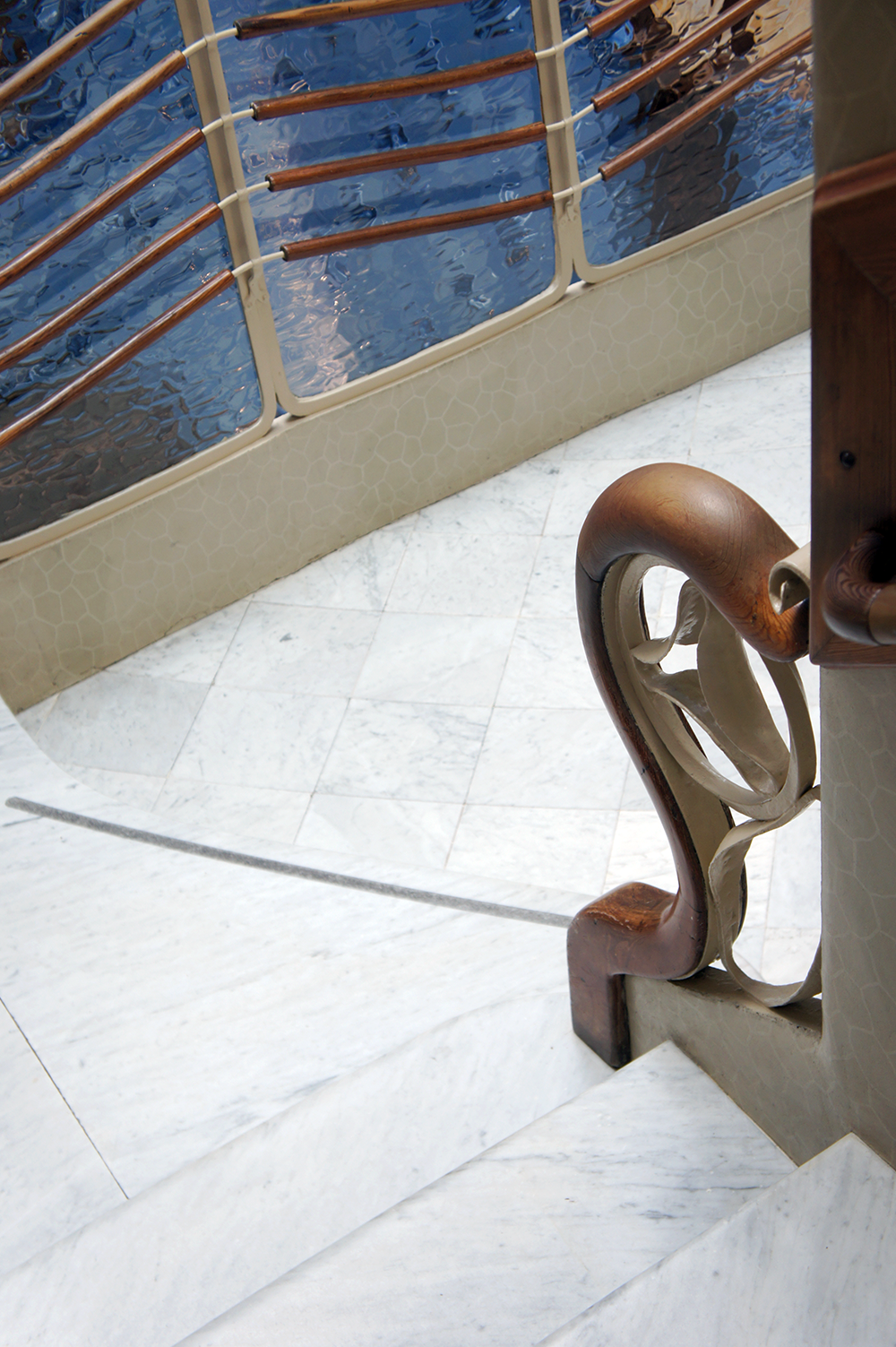
Welcoming us into the building was a white marble staircase, elegantly curving underneath a stained-glass ceiling. Upstairs can be found art and items from as early as the 12th century, in an eclectic mix including Romanesque statues, polychrome china, realist canvases and cubist compositions. Fidel de Tovar, the morning's photographer extraordinaire, shared his distaste for baroque. I secretly eyed an ornately-framed mural of a maiden on a swing. Fortunately, the collection covers a range of styles, balancing diversity and harmony while ultimately showcasing Francisco Godia's eclectic taste.

Francisco Godia Sales was an art enthusiast but he was more commonly known as Paco Godia, the gentleman racer who was the first Spanish to compete in Formula One. Driving for Maserati, he completed 14 races between 1951 and 1958, placing 6th in 1956. This was a success unmatched by any Spanish driver up until Alonso came along. Succeeding his retirement in 1969, Francisco Godia maintained ties with the world of motorsport, becoming influential in the development of Barcelona's Circuit de Barcelona-Catalunya race track.

The foundation contains a few objects from Paco Godia's racing days but its atmosphere adopts none of that which you'd associate with speed racing. In here, it's calm and still, sacred almost, encouraging decorum and contemplation. Alain de Botton has in recent years suggested the idea of museums as the secular world's new churches; at least in their being "places of consolation, meaning, sanctuary, redemption." I found my sanctuary alright, at least from the occasional bad behavior outside. As for redemption, I may have found it in being clean and competent, after the occasional bad behavior the previous night.

Fundación Francisco Godia, Barcelona. www.fundacionfgodia.org Photos by Fidel de Tovar, www.fideldetovar.net

February 24, 2015

That Organic Jewel


IT WASN'T ALWAYS MAGICAL. The building we now call Casa Batlló had existed for nearly 30 years before metamorphosing into the jewel we behold today. Built in 1877 by Antoni Gaudi, the property was just another building on Passeig de Gràcia, possessing none of its current features. 1904 marked the beginning of its transformation, having been purchased by Josep Batlló, who then commissioned Gaudi to rebuild the house into something creative. Gaudi convinced him that a renovation would suffice, and two years later emerged a terrific, fantastic creature of a building unlike anything on the glamorous avenue.

For its eclectic elements, Casa Batlló has been dubbed "house of bones", "house of masks", "house of yawns" and "house of the dragon". Ultimately, it took on the name of its founding father Josep Batlló. From the outside, the building draws attention with bone-like pillars and mask-like balconies protruding from a mosaic called trencadís. Crowning the building is a dragon-like roof, impaled by a flower-petal cross. The symbols allude to the legend of Sant Jordi, patron saint of Catalunya, who slew a dragon that terrorized the land.

Inside are curling rails, swirling ceilings, rib-like arches and light wells glimmering in an ocean of blue. Floral motifs abound, as do reptilian influences, all amidst a cornucopia of organic forms. The Noble Floor was opened to the public in 2002, and following unexpected popularity, other parts of the house were made accessible in subsequent years. Casa Batlló was listed as a Unesco World Heritage Site in 2005, and has since been recognized by various institutions for its achievements in conservation.

Four winters since moving to Barcelona, I remain convinced that the city's treasure is its architecture, particularly the Modernisme marvels that nurture tourism and patrimony. Of course there is the exuberant lifestyle, and the spirited drinking and dining culture that grows only richer with new trends. But these things can be adopted elsewhere. Architectural heritage is something that belongs uniquely to its home city. In Barcelona, Modernisme breathes the city's soul.

It's easy to take these buildings for granted when you live here, walking past them on the daily commute. Which is why I still tour the sights every now and then. Years pass but true gems don't lose their luster.

Casa Batlló, Barcelona. www.casabatllo.es Photos by Lady San Pedro and Jaime Sese.

July 25, 2013

That Alma Matter


ALMA BARCELONA ON CALLE MALLORCA has been open for some time now. But in the summer, the hotel adds to their list of offerings, the sun, the sky, La Pedrera, Sagrada Família and a plethora of Eixample rooftops on view at the terraza. There are two terraces actually: one presenting a scene of La Pedrera's rooftop warriors against Tibidabo's Sagrat Cor, and the other, an unobstructed view of Sagrada Família.

Alma is the Spanish word for "soul". Figuratively, as in English, the term can refer to the essence of a thing or embodiment of a quality. El alma de la fiesta, "the life and soul of the party". El alma del proyecto, "the driving force behind the project". Perhaps it's only fitting that in a hotel called Alma Barcelona, you can revel in a cava, a cocktail, Modernisme, open air and the swift Barcelona dusk that ushers in those long, balmy summer nights.  

El alma de la ciudad, "the city's soul" comes alive in the summer. And it serves cocktails daily from 7pm to 1am.

Alma Barcelona, www.almabarcelona.com Photos by Lady San Pedro.

February 4, 2013

This Barrio Lass


THIS FEBRUARY MARKS OUR FIRST YEAR in Barrio Sant Gervasi. Usually referred to in conjunction with neighboring Sarrià, the two make up a considerable part of the hilly Zona Alta and one of the largest districts in Barcelona.

With lower commercial activity compared to other barrios in the city, Sant Gervasi seldom sees tourists and maintains a more local neighborhood atmosphere. Upon arriving last winter, we felt every bit the new kids in town, with everyone seeming to have already known each other for years, even decades. But the folk are friendly; quick to know us by name and eager to chat despite language barriers. If you're amicable, they tend to be too.

There aren't too many large or chain establishments in Sant Gervasi, as many of the stores are locally owned and run. As such, day-to-day shopping feels quaint, with individual trips to, or plotted routes covering, what I call the "ías": the panadería (bakery), frutería (fruit and vegetable stand), charcutería (deli), carnicería (butcher), tintorería (dry cleaners), papelería (office supplies shop), perfumería (cosmetics shop), ferretería (hardware shop), floristería (florist) and lampistería (electrical shop), listed here in order of my personal frequenting.

Of course, the old-fashioned way is not always the most convenient. Supermarkets offer one-stop shopping, loyalty points and store hours uninterrupted by the 2:00-4:30 lunch and siesta break. I vouch for its benefits, having gained my primary and premium loyalty cards within mere months.

But when the sun is shining and there's a morning to spare, there's nothing quite like meandering the "ías" of the barrio. Cultural nuances, glamorous grandmas, random conversations with leisurely retirees. I vouch for its charm.

Parc de Monterols, Plaça d'Adrià and Carrer de Muntaner, Sant Gervasi, Barcelona. Photos by Lady San Pedro.
« NEWER OLDER »