EST. 2009

showing posts filed under: Barcelona
Showing posts with label Barcelona. Show all posts

May 21, 2015

Those Crowning Moments


"THEY ARE NOT LONG, THE DAYS OF WINE AND ROSES." reads the first line of the second stanza of Ernest Dowson's appropriately short poem. Neither are the nights, if I may add, in which friends and flavors go so pleasurably together, and before you know it, the night has run out with the wine. That wasn't entirely the case however at the Viñedos Singulares dinner party, where wine outlasted the whole bunch of us who had to head back home.

Celebrated at the brand's cellar, dressed to the nines for a night, the dinner was dedicated to the pairing of flavors in the company of friends. Degustation kicked off with a teriyaki tuna tataki paired with the clean and brillant Vino Afortunado. A pear and salmon canapé accompanied a second white: the fresh, easy Albariño-varietal Luna Creciente. Iberian pork with cranberry sauce came with the lightly mineral Corral del Obispo, sirloin tartare with the fruity Jardín Rojo, and oxtail in raspberry sauce with the intense Entrelobos. Big Band tracks encouraged dancing, interrupted only by cheese platters served with the subtly spicy El Veïnat.

Pairing seemed recurrent that evening. With dishes prepared in Caravan Made's vintage roving kitchen, and wines seemingly plucked fresh from Viñedos Singulares' warehouse shelves, there is a sense of matching old and new, vintage and young. Resurrected from the 1970s, Caravan Made's food truck literally brings gastronomy to markets and festivals dominated by a hashtagging crowd. Viñedos Singulares dedicates to the same set, with fresh, easy flavors that stay essentially true to their Designation of Origin. Never more than a couple years old, the wines move at the same pace as its consumers, driven by trend culture and the natural restlessness of youth.

Founded in 2007, the cellar works with six wineries in La Rioja, Ribera del Duero, Bierzo, Rías Baixas, Rueda and Montsant, visiting each zone to administer the winemaking process from birth to bottle. On this particular night they followed through to the table and on the dance floor, joined by some of Barcelona's food and lifestyle propagators. Such was the night of "wine and roses", or in this case, wine and grapevine, which made for excellent crowns. After all the careful prepping and pairing, what food and wine really provide us are a few delightful and fortunate moments. Here's to the next!

Vino Afortunado, Luna Creciente, Corral del Obispo, Jardín Rojo, Entrelobos and El Veïnat by Viñedos Singulares, vinedossingulares.com Gastronomy by Caravan Made, caravanmade.com Photos by Raúl Muñoz.

March 19, 2015

That Saturday Calm


ROWDY TOURISTS EXCHANGED HOOTS AND HOWLS as I turned into Calle Diputación. I saw Fidel shake his head in disapproval before returning to his reading, which I interrupted with my arrival. It was a Saturday morning and we had scheduled to meet at Fundación Francisco Godia. Established by Liliana Godia in memory of her father, the foundation occupies the magnificent Casa Garriga Nogués and houses up to 1,500 paintings, sculptures and ceramics from Francisco Godia's legacy. New pieces continue to be added to the collection each year, and yet it manages to still feel uncluttered in spite of its ever-growing size.

Welcoming us into the building was a white marble staircase, elegantly curving underneath a stained-glass ceiling. Upstairs can be found art and items from as early as the 12th century, in an eclectic mix including Romanesque statues, polychrome china, realist canvases and cubist compositions. Fidel de Tovar, the morning's photographer extraordinaire, shared his distaste for baroque. I secretly eyed an ornately-framed mural of a maiden on a swing. Fortunately, the collection covers a range of styles, balancing diversity and harmony while ultimately showcasing Francisco Godia's eclectic taste.

Francisco Godia Sales was an art enthusiast but he was more commonly known as Paco Godia, the gentleman racer who was the first Spanish to compete in Formula One. Driving for Maserati, he completed 14 races between 1951 and 1958, placing 6th in 1956. This was a success unmatched by any Spanish driver up until Alonso came along. Succeeding his retirement in 1969, Francisco Godia maintained ties with the world of motorsport, becoming influential in the development of Barcelona's Circuit de Barcelona-Catalunya race track.

The foundation contains a few objects from Paco Godia's racing days but its atmosphere adopts none of that which you'd associate with speed racing. In here, it's calm and still, sacred almost, encouraging decorum and contemplation. Alain de Botton has in recent years suggested the idea of museums as the secular world's new churches; at least in their being "places of consolation, meaning, sanctuary, redemption." I found my sanctuary alright, at least from the occasional bad behavior outside. As for redemption, I may have found it in being clean and competent, after the occasional bad behavior the previous night.

Fundación Francisco Godia, Barcelona. www.fundacionfgodia.org Photos by Fidel de Tovar, www.fideldetovar.net

February 24, 2015

That Organic Jewel


IT WASN'T ALWAYS MAGICAL. The building we now call Casa Batlló had existed for nearly 30 years before metamorphosing into the jewel we behold today. Built in 1877 by Antoni Gaudi, the property was just another building on Passeig de Gràcia, possessing none of its current features. 1904 marked the beginning of its transformation, having been purchased by Josep Batlló, who then commissioned Gaudi to rebuild the house into something creative. Gaudi convinced him that a renovation would suffice, and two years later emerged a terrific, fantastic creature of a building unlike anything on the glamorous avenue.

For its eclectic elements, Casa Batlló has been dubbed "house of bones", "house of masks", "house of yawns" and "house of the dragon". Ultimately, it took on the name of its founding father Josep Batlló. From the outside, the building draws attention with bone-like pillars and mask-like balconies protruding from a mosaic called trencadís. Crowning the building is a dragon-like roof, impaled by a flower-petal cross. The symbols allude to the legend of Sant Jordi, patron saint of Catalunya, who slew a dragon that terrorized the land.

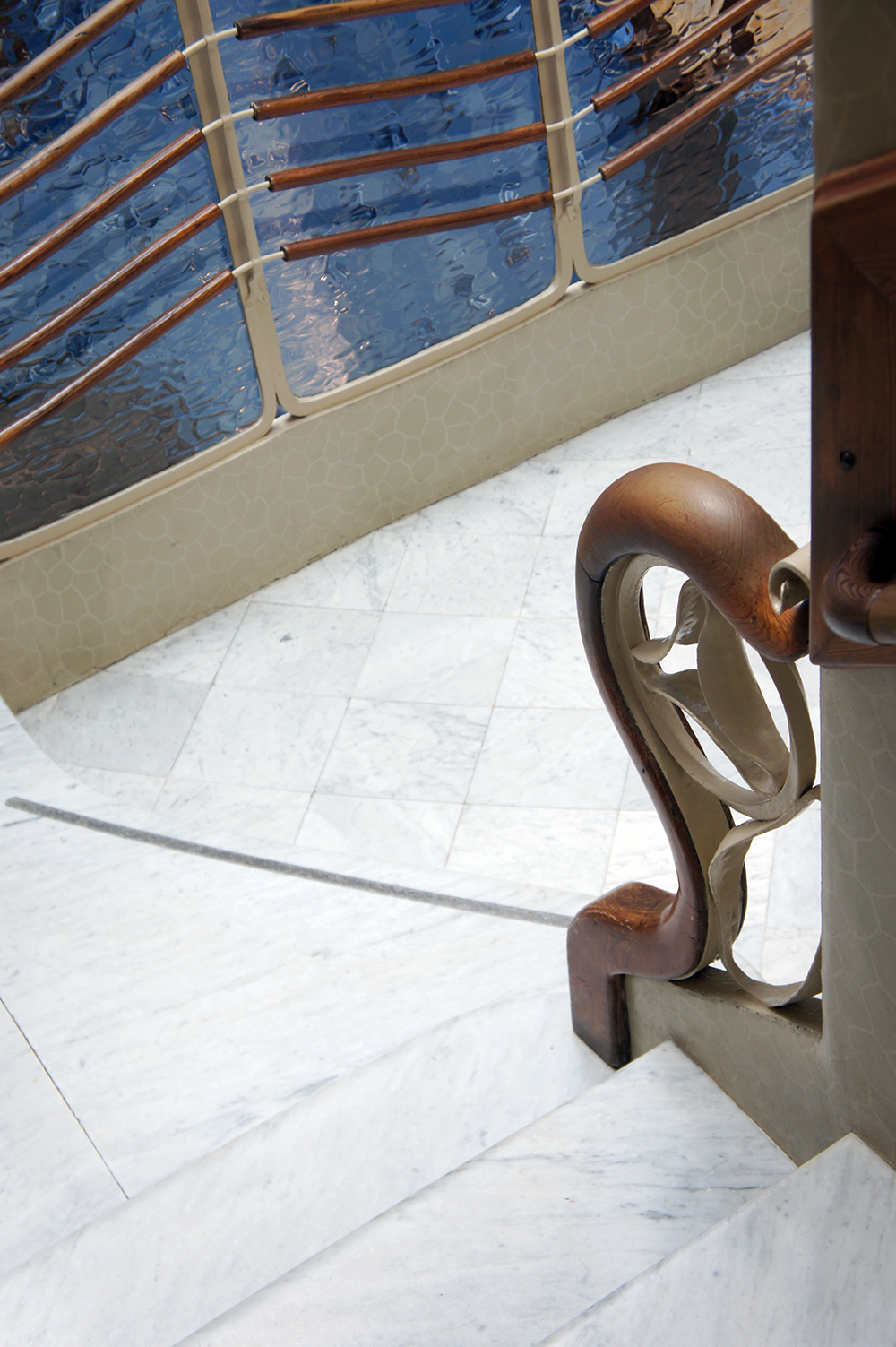
Inside are curling rails, swirling ceilings, rib-like arches and light wells glimmering in an ocean of blue. Floral motifs abound, as do reptilian influences, all amidst a cornucopia of organic forms. The Noble Floor was opened to the public in 2002, and following unexpected popularity, other parts of the house were made accessible in subsequent years. Casa Batlló was listed as a Unesco World Heritage Site in 2005, and has since been recognized by various institutions for its achievements in conservation.

Four winters since moving to Barcelona, I remain convinced that the city's treasure is its architecture, particularly the Modernisme marvels that nurture tourism and patrimony. Of course there is the exuberant lifestyle, and the spirited drinking and dining culture that grows only richer with new trends. But these things can be adopted elsewhere. Architectural heritage is something that belongs uniquely to its home city. In Barcelona, Modernisme breathes the city's soul.

It's easy to take these buildings for granted when you live here, walking past them on the daily commute. Which is why I still tour the sights every now and then. Years pass but true gems don't lose their luster.

Casa Batlló, Barcelona. www.casabatllo.es Photos by Lady San Pedro and Jaime Sese.

September 9, 2014

That Starlight Starbright


SET AGAINST A GLOWING SKY AND A DAZZLING PANORAMA of Barcelona city lights, creative courses ushered in the nightfall. It was around 9pm on a Saturday and we appreciated the drop in temperature on the Collserolla hills, where the Fabra Observatory hosts Sopars amb Estrelles through the summer months.

The dinners begin on the terrace, offering astronomy-inspired gastronomy through a selection of degustation menus. What follows is a tour of the observatory, inaugurated in 1904, and ever since been home to the 1904 Mailhat telescope: the oldest and largest telescope still in use in Europe. With clear skies, we had a chance to peer through the 1904 Mailhat and observe the distant heavens. We did not look at any stars but we did see Jupiter, aglow and afloat in pitch-black infinity.

It was a quick, wonderful, spectacular blur, trying to make out surface details and then being conscious not to keep everyone else waiting their turn. Unlike celestial bodies, we earthlings share a much smaller space, with a much larger group of others to share with. We are never really without company. So while it is at once empowering and belittling to see something that is millions of miles away, it is ultimately comforting to recognize that great distances exist, and that a void exists, but that neither of them in fact exist among us unless we create them.

Looking down at our screens so much nowadays, it may be a good idea to look up sometimes and observe something inspiring. "Astronomy," as it is argued in book seven of Plato's The Republic, "compels the soul to look upward, and leads us from this world to another." Yeah that, plus a good dinner. We are still earthlings after all.

Sopars amb Estrelles, Barcelona www.soparsambestrelles.cat Photos by Lady San Pedro and Jaime Sese.
« NEWER OLDER »